

Small House, Big Sky — The New Logic of Tiny Homes and the Land Beneath Them
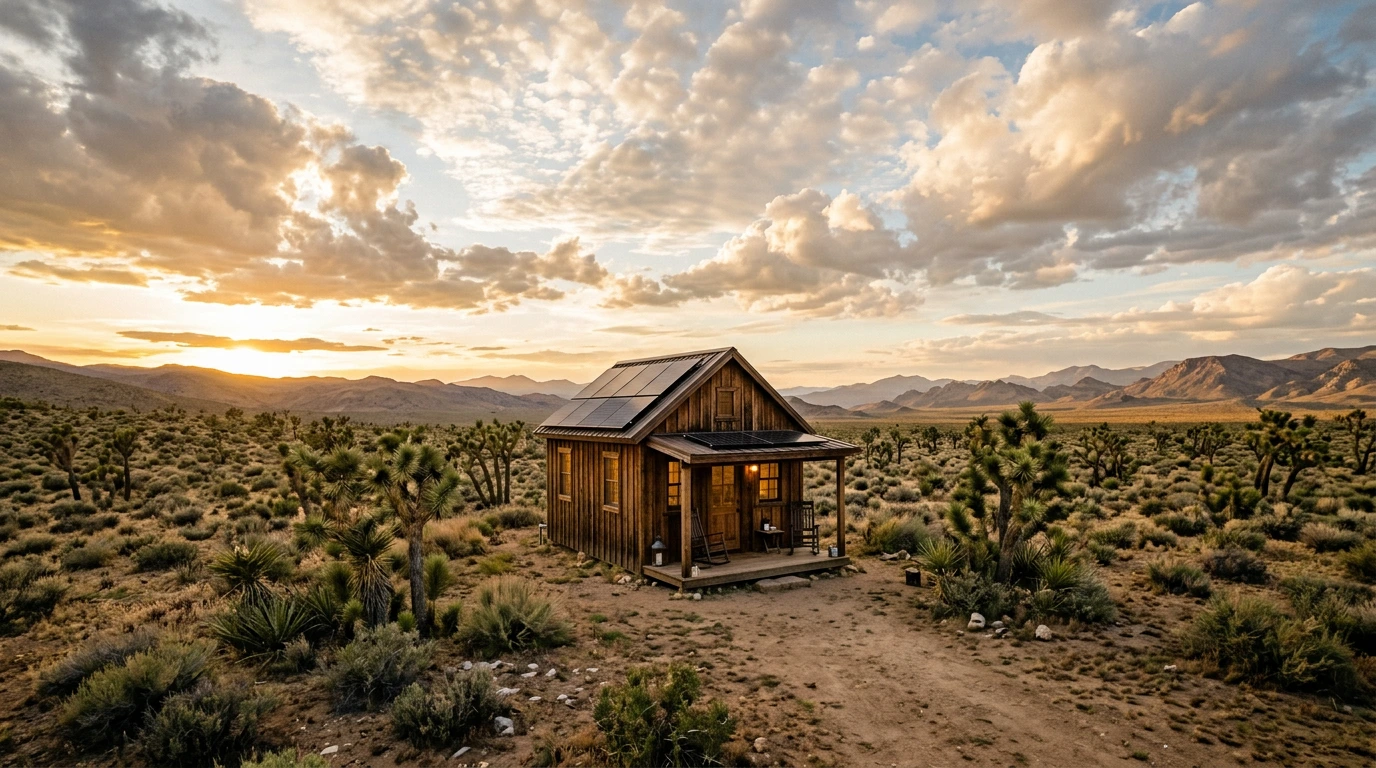
The tiny home movement began, as most genuinely useful ideas do, partly from necessity and partly from a kind of blessed stubbornness. People looked at the American housing market — its impossible prices, its forty-year mortgages, its beige-carpeted rooms nobody uses — and decided, quietly but in increasing numbers, to opt out. Not out of despair but out of a dawning preference for a different set of trade-offs.
The numbers have caught up with the feeling. The global tiny homes market is currently valued at roughly $1.4 billion and is growing steadily, projected to reach nearly $1.8 billion by 2031. That's not a fringe movement anymore. That's a constituency. Remote work — which by 2025 accounted for more than a quarter of full-time U.S. employment — has untethered people from commute distances, meaning a couple in Sacramento or San Jose can now reasonably ask themselves: why exactly are we paying these prices to be this close to an office we no longer attend?
The answer, increasingly, is: we don't have to be. And so they start looking at land.
What makes the tiny home phenomenon interesting isn't merely the economics, though the economics are genuinely interesting. It's the philosophy underneath — the deliberate refusal to define quality of life by square footage. The average tiny home runs around 225 square feet, roughly one-ninth the size of the average American house. What gets lost in the arithmetic is what also gets gained: lower maintenance, lower debt, and all those hours and dollars that used to disappear into the upkeep of rooms you barely entered now redirected toward the actual business of living.
Most tiny homes in the U.S. are built on rural land, which presents fewer zoning obstacles than urban settings and offers the essential ingredient the movement requires: space around the structure. The tiny house works best, philosophically and practically, when it opens onto something large. A meadow, a ridgeline, a stretch of desert flooring that runs to the horizon. The house is small so the world outside it can be enormous. That's the deal. And for the people who understand that deal, it's a very good one.
In California, this has taken on particular resonance. The state's housing crisis has driven land-seeking buyers into regions they might not have considered a decade ago — the high desert east of Los Angeles, the oak woodlands of the Sierra foothills, the volcanic landscapes of the far north. And what they're finding, in many cases, is that the land itself is the revelation: that it was the land they wanted all along, and the tiny home is simply the honest expression of that want.
The off-grid dimension of this movement deserves its own mention. Living off-grid in California has graduated from the province of back-to-the-land idealists to something approaching mainstream aspiration. Buyers across the state are pursuing independence from utility grids through solar arrays and rainwater collection, drawn by a combination of practical frugality and a desire for the particular satisfaction of generating your own power and catching your own water from the sky that falls on your own land. There is a rightness to that loop — a closed, self-sufficient elegance — that appeals to something fundamental in people who've grown weary of depending on systems they can't see and don't understand.
None of this requires asceticism. A well-designed tiny home on good land in good country can be one of the more civilized arrangements a person makes. The bed faces the window. The window faces the hills. The hills do what hills have always done: they stay there, patient and indifferent and beautiful, and give the person looking at them a decent sense of proportion.